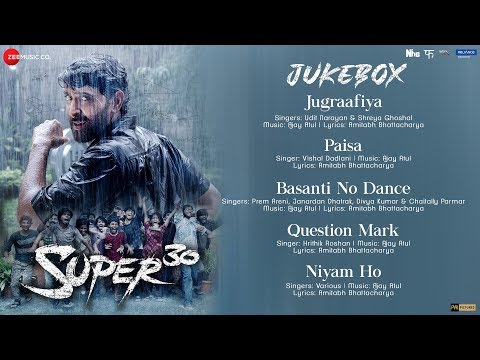
There has been an inquisitive instance of time misplacement with Hindi film soundtracks this year. While so far it was period films that have included contemporary sounds (Kalank, Bharat and so forth), in Super 30 the inverse is the situation. There are different melodies from the collection that behold back to times sooner than the film’s subject Anand Kumar’s course of events would demonstrate. It probably won’t make any difference much if the melodies are great obviously, and regardless of their sketchy run a year ago, Ajay-Atul’s music is consistently an energizing prospect.
Before I dig further into my bandy above, let me pick the one tune from the collection where the sound and the time go connected at the hip – the lovely, though equation based, sentimental piece ‘Jugraafiya’. A few of the melody’s components are trademark Ajay Atul – a stupendous setting set apart by clearing violins, the three step dance y beat and so on. Be that as it may, when the percussion hits, it transforms into a 90s number (aside from more joyful). It likewise helps that the man behind the mic is Udit Narayan, sounding significantly superior to anything he has in his incidental ongoing trips. Giving Narayan organization is the splendid as-consistently Shreya Ghoshal. I very preferred the regionalisation that lyricist Amitabh Bhattacharya done to “topography” with the title.
Be that as it may, am I the one in particular who experiences issues handling the expression, “safedi ki chamkaar” in a sentimental setting? Proceeding onward to ‘Paisa’ – melodiously a tribute to the Mammon, yet musically the track is a conspicuous return to the 70s. The rush, the enthusiasm is reproduced effectively by the writers, however it additionally accompanies a lot of dreariness. Vishal Dadlani on vocal obligation is an incredible decision here.
Proceeding on a similar retro, sensational note, however with a lighter, snazzy base (and thusly including some great utilization of horns and bass) is ‘Question Mark’. The track is conversational and analytical in nature, after a design, and has the film’s principle man Hrithik Roshan driving the vocals. While I can’t definitively remark on Roshan’s articulation, his conveyance works and he gets support from the ensemble. The unexpected switch in rhythm in the subsequent half tips the scale a bit towards a 70s mode a la ‘Paisa’, be that as it may, I found this an all the more captivating undertaking.
The track, ‘Basanti No Dance’, as you can figure, is a joking reference to the exemplary Dharmendra quote from Sholay. The melody is clearly a Holi tune, yet the spotlight isn’t such a great amount on the celebration for what it’s worth on observing Hindi (strangely on occasion the percussion appears to reference another religion Holi tune – ‘Jai Shiv Shankar’). The counterfeit English lines get overwhelming after a point however. It’s a decent demonstration of extravagance by the artists Prem Areni, Janardan Dhatrak, Divya Kumar and Chaitally Parmar. With the anthemic ‘Niyam Ho’ Ajay-Atul are back in their home turf – stupendous symphonic sound, harmonies et al, and the arrangers expert it like they generally do.
Bhattacharya’s lines that tirade against social imbalances and so forth, show this is the motion picture’s signature tune, and the tune conveys them astonishingly.
 Ahmad's perspective